Saturday, 21 December 2019

Quantity of Cement and Sand Calculation in Mortar


Quantity of Cement and Sand Calculation in Mortar

Quantity of cement mortar is required for rate analysis of brickwork and plaster or estimation of masonry work for a building or structure. Cement mortar is used in various proportions, i.e. 1:1, 1:2, 1:3, 1:4, 1:6, 1:8 etc.

Calculation of quantity of cement mortar in brickwork and plaster:

For the calculation of cement mortar, let us assume that we use 1m3 of cement mortar. Procedure for calculation is:
1. Calculate the dry volume of materials required for 1m3 cement mortar. Considering voids in sands, we assume that materials consists of 60% voids. That is, for 1m3 of wet cement mortar, 1.6m3 of materials are required.
2. Now we calculate the volume of materials used in cement mortar based on its proportions.
Let’s say, the proportion of cement and sand in mortar is 1:X, where X is the volume of sand required.

Then, the volume of sand required for 1:X proportion of 1m3 cement mortar will be
3. Volume of cement will be calculated as:
Since the volume of 1 bag of cement is 0.0347 m3, so the number of bag of cement will be calculated as:
                                                     
Example:
For cement mortar of 1:6, the quantity calculated will be as below:
Sand quantity:
Quantity of cement (in bags):
Volume of cement = 
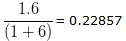
There number of bags required =  = 6.58 bags.

How To Calculate Slope Of Staircase

How To Calculate Slope Of Staircase


Staircase is one of the most important components of a building. It helps people to access different floors of a building. When it comes to constructing a staircase, it is always important that you correctly calculate the slope of the flight to ensure that it isn’t too step.

The calculation of staircase slope is very simple and easy. You just need to know the width of tread and height of riser. After calculating, you will come to know whether the stair slope is 
legal or not.

Step 1:

Measure the distance of treads (Exclude the width of nosing). If all the treads are uniform in size, measure one tread otherwise you will need to measure all treads.
Let the width of tread = 250 mm.

Step 2:

Measure the height of risers. If risers are all uniform in size measure only one. If they are different sizes you will need to measure all risers.
Let the height of riser = 150 mm.

Step 3:

Divide the riser height by the tread width and then calculate the inverse tangent.
tanθ = Riser Height/Tread Width = 150/250 = 0.6
∴ θ = tan−1 0.6 = 31°
Keep in mind that tread and riser of uniform size ensure easy measurements and more accurate results. I advise you to build a staircase that it’s slope is not too steep or steep enough (Staircase slope between 30° to 40° is considered as standard).

Tips for Home construction


Tips for Home construction

Carefully Select the Builder:
Before hiring a builder, drive past their previous jobs and speak to the homeowners. Ask if the builder had good follow-through, whether the job was completed on schedule and on budget and if they were pleased with the quality of work. Also, check the builder's relationships with subcontractors and supply houses — essentially find out if they pay their bills. A builder who is behind in payments will most likely encounter delays in receiving materials and have a hard time keeping a quality crew.
Hire a Lawyer:
Have a lawyer review the contract with your builder. Building a home is a major investment and it's important to make sure all of your bases are covered. A small lawyer fee up-front could save you thousands of dollars should something go wrong during construction.

Investigate the Area:
Before purchasing land, research the school district and crime rate. Drive around the surrounding area, checking for convenience to interstates, schools, shopping and restaurants.
Don't Overbuild:
Before finalizing home plans and beginning construction, compare the home you're planning with others on the same street. You never want to be the most expensive house on the block; you won't get your money back when you sell.
Don't Select a Builder Based Solely on Bid:
When choosing a builder, don't select the one with either the highest or lowest bid. A high bid doesn't guarantee a superior product and the lowest bid could mean that you'll be hit with extra costs as construction progresses. Often, the low number is to reel you in and the extras will be tacked on later.
Hire Locally:
Word-of-mouth references are a good gauge of a builder's reputation. So ask around, then hire the best builder in the community. A well-established local builder will have plenty of nearby subcontractors and suppliers to rely on, meaning no costly travel delays while waiting for out-of-town crews and materials.
Build for Your Future:
When planning your home's layout, think not only about your current lifestyle but also plan for a few years down the road. For older adults, a master bedroom on the ground floor is a smart bet. Also, including a shaft that could one day be an elevator is a good idea. The space could be used as closets now and easily converted to an elevator should the need arise.
Don't Go With the Latest and Greatest:
Fill your home with technology that will stand the test of time. State-of-the-art features are great but quickly become outdated. Buy products that have been on the market for a year or two. They're less expensive, readily available and any initial kinks and design flaws have been worked out.
Avoid Trends:
Nothing betrays a home's age like trendy, of-the-moment fixtures. Let's say that Brazilian cherry hardwood is all the rage, then it goes out of style making your home look dated. Select fixtures and features that are classic so your home always looks current.

Tuesday, 17 December 2019

CIVIL ENGINEERING DIFFERENT UNITS CONVERSION FACTORS

Image result for construction

FEET OR METERS:

1 Feet = 12 inches
1 Feet = 0.3048 meter
1 Feet = 0.0929 meter square
1 Inch = 25.4 mm
1 Meter = 1,000 mm
1 Meter =3.281 feet
1 Meter = 1.094 yard
1 Meter Square = 10.764 square feet

CENTIMETER:

1 Centimeter = 0.3937 inches
1 Centimeter = 0.032808 feet
2.54 Centimeter= 1 inch
30.48 Centimeters = 1 Foot
91.44 Centimeters = 1 yard
1 karam = 5.5 feet
1 karam = 1.67 meter
1 square Karam =  30.25 square feet
1 square Karam = 2.679 meter square

MARLA:


1 Marla = 272.24 square feet = 9 square karam
1 Marla =  25.10 meter square

KANAL:

1 Kanal  = 20 Marla = 5444.8 square feet (since, 1 Marla = 272.24 Square feet)
1 Kanal  =  502 meter square (since, 1 Marla = 25.10 meter square)
1 Kanal  =  180 square Karam (since 1 Marla = 9 square Karam)

 ACRE:

1 Acre =  43,560 Square Feet
1 Acre =  160 square rods
1 Acre = 10 square chains
1 Acre = 160 poles
1 Acre = 0.4047 Hectare
1 Acre = 100 square meters

HECTARE:

1 Hectare = 10,000 Square meter
1 Hectare = 107,639 sq ft
1 Hectare = 11959.8 sq. yards
1 Hectare = 11959.8/4840 = 2.47 acre

FOOT OR FURLONG:


1 Foot =  12 inches
1 Foot = 0.36 vars
1 Foot = 0.3048006
1 Furlong = 660 feet
1 Furlong =40 rods

LINK:

1 Link = 7.92 inches
1 Link = 0.66 feet
1 Link = 0.2017 meter

MILE:

1 Mile = 5280 feet
1 Mile =8 furlong
1 Mile = 320 rods
1 Mile = 80 chains
1 Mile =  1.60935 kilometers
1 Mile = 320 perches


1 Mile = 800 links
1 Mile = 1609.2655 meters
1 Mile Square = 27,878,400 square feet
1 Mile Square = 2.59 square hectares

PERCH, POLE OR ROD:

1 Perch = 25 links
1 Perch = 1 pole
1 Perch = 1 rod
1 Perch = 16.5 feet
1 Pole = 16.5 feet
1 Pole = 1 perch
1 Pole = 1 rod

YARD:

1 Yard = 36 inches
1 Yard = 3 feet
1 yard = 0.9144 meters
1 Yard = 91.44 centimeter
1 Square Yard = 9 square feet